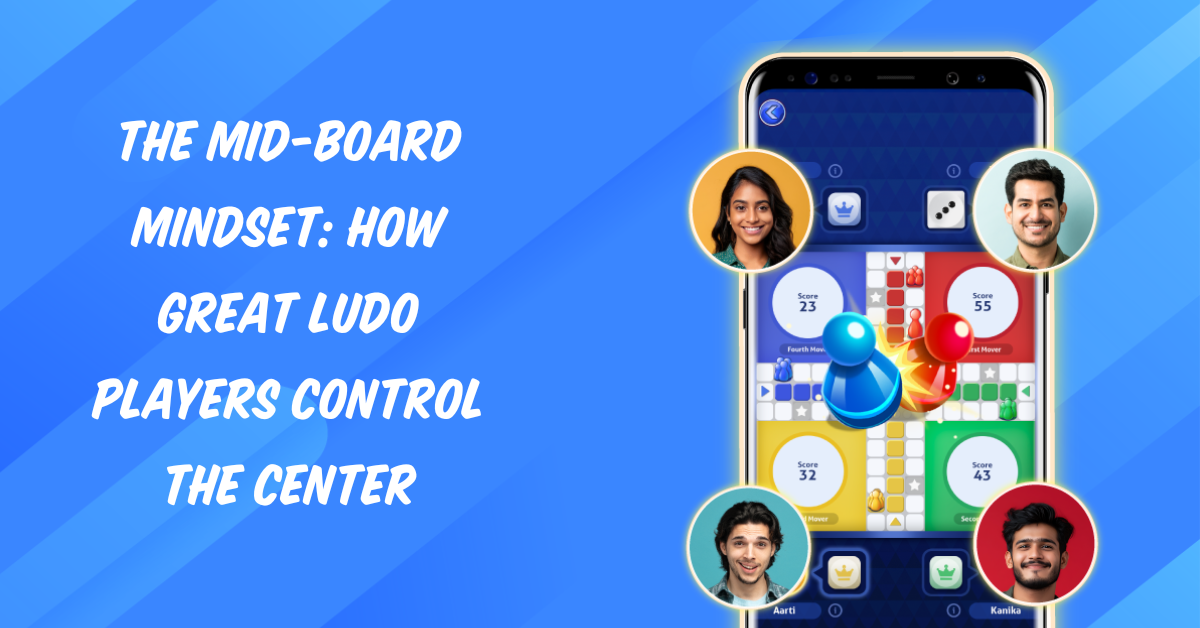
In Ludo, most people think in straight lines—you move your tokens out, put them in front of you, and make a beeline for home. But in a game of Ludo, one of the most common things overlooked is where all the magic happens—the middle part of the board. The middle part of a game board is not simply a place you travel from start to finish but rather a place where you build pressure, create momentum, and make your opponents self-correct.
Whether you’re playing on a physical board or an online version such as ludo online, a good player considers the middle of the board a strategic area rather than a passing area. They will not move through it without thinking. Rather, they can use it as a means to slow other players down, among other things.
The mid-board mindset is what differentiates winning players from recreational players.
Why the Mid-Board Matters More Than the Start or End
The opening phase of Ludo is essentially reactive: you are waiting for sixes, getting the tokens out, and avoiding early cuts. The endgame, near home, is often about counting exact rolls. But the mid-board is different, and that is where decision-making has its biggest impact.
Tokens are exposed in the middle of the board, safe squares are small in number, and several players’ paths cross each other. That’s interaction. Every move there will affect not just your position but the options available to others.
Great players know controlling the mid-board doesn’t mean occupying every square. It means placing tokens in a manner such that it limits your opponent’s freedom while you yourself can retain most of your flexibility.
Positioning Tokens to Apply Silent Pressure
In order to achieve mid-board control, a player should have their pieces spaced apart from each other. If all of the same player’s pieces are grouped together on the board, they are easier for an experienced opponent to predict and exploit.
Experienced players will try to utilise mid-board control by spreading out their pieces throughout the middle of the board so that they can be positioned close to the areas in which their opponents are most likely to travel through.
When a player’s piece sits within one to six spaces of an opponent, a psychological advantage is created. Even without an immediate attack, this proximity builds anxiety and uncertainty, influencing how the opponent thinks and moves. In multiplayer games, this pressure often forces cautious choices, slower progress, and suboptimal token selection, all without a single cut being made.
Using the Center to Control Tempo
In Ludo, tempo refers to the game’s movement speed for any particular player that is either slow or fast. The middle of the board is the portion where a player could intentionally change the tempo.
Slowing the game down helps to protect an advantage if you are ahead. Keeping tokens in the mid-board forces opponents to play cautiously, delaying their progress. If you’re behind, well-timed mid-board positioning can create opportunities to reset opponents and rebalance the game.
The strong players do not rush through the center if the board is not clearly safe. They wait, watch, and make only those moves which decidedly better their position. Their patience frustrates the aggressive players who then make mistakes in attempting to force progress.
Mid-Board Mistakes Average Players Make
A lot of losses in Ludo can be attributed to mid-game blunders.
Some typical blunders include:
- Speeding in a danger zone, relying on luck to shield the token
- Prying into safe squares too soon, unveiling tokens prematurely
- Having a single lead token, which is the obvious target
- To ignore the positions of other players and focus attention solely on individual advancement
Such errors arise mostly because of impatience. Players want to “get past” the middle of the court in order to reach their destination quickly, without understanding that this is where the game is really being played.
If you want to become a Ludo King, watch how the middle of the board decides everything. Quick turns expose rushed thinking. Players who sprint through the center are repeatedly sent back, while those who move quietly, hold space, and stay patient build power without drawing attention.
Reading Opponents Through Mid-Board Behavior
How a person acts on the center of the board shows who they are as a player. Cautious players are paralysed with fear when they feel threatened. Aggressive players continue to push forward no matter the risk. Uncertain players flip their tokens erratically without having a detailed strategy.
By watching patterns that emerge from each player’s actions, you can build a solid understanding of what decisions each player will make even before they make them. When a player continually avoids taking risks, place your token adjacent to theirs so that their fear hinders their ability to move. When another player consistently charges forward, position yourself behind your opponents and simply wait. The actions that occur on the middle section of the board provide you with a basis to better understand how your opponents are thinking.
This understanding of how players are thinking turns Ludo into a game of anticipating another player’s moves versus reacting to them after they have happened.
Turning Mid-Board Control into Wins
Controlling the mid-board doesn’t win the game immediately, but it creates favorable conditions for winning later. It preserves tokens, forces opponents into inefficient moves, and increases your chances of reaching the endgame with momentum.
The strongest players don’t dominate through flashy moves. They win because their opponents feel constantly restricted, unsure, and pressured—especially in the center of the board. By the time the final stretch arrives, the outcome often feels inevitable.
Conclusion
The mid-board is the heart of Ludo strategy. It’s where positioning, timing, and awareness matter most. Players who treat it as a passing zone give up control. Players who treat it as a strategic space dictate the flow of the game.
Whether you’re playing casually, competing online, or facing experienced opponents in versions like online ludo, adopting the mid-board mindset changes how you play. You stop rushing. You start observing. And most importantly, you begin shaping the game instead of letting the dice shape it for you.