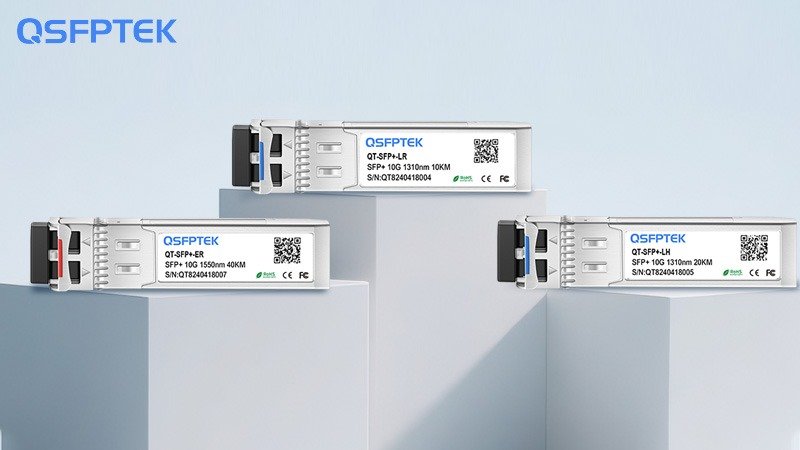
With fiber resources becoming increasingly scarce, this technology doubles network transmission efficiency.
In modern network infrastructure, the 10G BIDI SFP+ optical module, with its unique technical advantages, has become a key solution for optimizing fiber resource utilization.
Unlike traditional optical modules, BIDI SFP+ modules utilize wavelength division multiplexing (WDM) technology, enabling simultaneous bidirectional signal transmission over a single fiber, saving up to 50% of fiber resources.
This feature makes them highly desirable in applications where fiber resources are limited or cost-sensitive.
How Does a Single Fiber Achieve Bidirectional Transmission?
The core of the 10G BIDI SFP+ lies in its single-fiber bidirectional transmission capability. Compared to conventional SFP+ modules, it integrates a WDM (Wavelength Division Multiplexing) to transmit and receive data using optical signals of different wavelengths.
Each BIDI module is assigned a specific wavelength combination, with common pairs such as 1270nm/1330nm or 1490nm/1550nm. This design prevents interference between different wavelengths when signals are transmitted over a single fiber, enabling full-duplex communication.
The module uses an LC simplex connector internally, requiring only a single fiber connection. This significantly simplifies cabling compared to traditional dual-fiber connections.
Why Choose BIDI SFP+?
The most significant advantage of BIDI SFP+ is its fiber resource savings. By combining the transmission tasks of two fibers onto a single fiber, it directly reduces fiber usage and the number of patch panel ports, lowering infrastructure costs.
In existing network expansion projects, when fiber duct space is insufficient or the cost of installing new fiber is prohibitive, BIDI technology enables network upgrades without adding new fiber.
The module utilizes a compact SFP+ form factor, the same size as a standard SFP, yet delivers 10Gbps high-speed transmission capabilities, supporting high-density switch ports and maximizing rack space utilization.
Furthermore, BIDI SFP+ modules typically consume less than 1W of power, offering significant energy savings that can significantly reduce operating costs in large-scale deployments.
Application Scenarios: Where Can It Maximize Its Value?
Enterprise networks and data centers are the primary application areas for BIDI SFP+. In these environments, it supports 10G Ethernet transmission, helping organizations expand network capacity without increasing fiber cabling.
4G/5G mobile communication networks also benefit from this technology. In wireless fronthaul networks, BIDI SFP+ modules connect radio units and baseband units, conserving fiber resources between base stations and the core network.
Industrial-grade BIDI SFP+ modules feature a wide operating temperature range of -40°C to 85°C, suitable for stable operation in harsh environments and meeting the requirements of applications such as industrial automation and outdoor base stations.
For long-distance transmission, specific models such as the 10G BIDI SFP+ ZR module support transmission distances of up to 80 kilometers, making it an ideal choice for metropolitan area network interconnection.
Critical Factors for Successful Deployment
BIDI SFP+ modules must be used in pairs, and the wavelengths of the modules at both ends must match.
For example, if one end uses a module that transmits at 1330nm and receives at 1270nm, the other end requires a matching module that transmits at 1270nm and receives at 1330nm.
Before deployment, ensure that the fiber type is single-mode fiber. BIDI SFP+ is designed specifically for single-mode fiber and covers transmission distances ranging from 10GBASE-BX10 10km to 10GBASE-BX80 80km. Select the appropriate module model based on the required distance.
Most modern BIDI SFP+ modules support digital diagnostic monitoring, allowing network administrators to monitor module parameters such as temperature, optical power, voltage, and bias current in real time, facilitating proactive maintenance and troubleshooting.
Choosing matching modules of the same brand and specifications ensures a perfect match of wavelength parameters, preventing compatibility issues from impacting transmission quality.
Conclusion
As network bandwidth demands continue to grow, fiber resources are becoming increasingly scarce. 10G BIDI SFP+ technology not only provides a cost-effective solution today but also plays a crucial role in supporting the future evolution of network architectures towards higher density and higher performance.
For enterprises planning a 10G network upgrade, evaluating existing fiber resources and future needs is the first step.
If fiber infrastructure is limited or expansion costs are high, BIDI SFP+ is undoubtedly a solution worth investing in, allowing enterprises to maintain connection efficiency and stability amidst growing network demands.